Why Your Garage Door Opens by Itself, and How to Stop It
A door that moves when nobody touched it is unsettling, and occasionally it is a security problem. Almost always, it is one of six ordinary faults.
By Garage Door Care of Round Rock · · 6 minute read
Six Causes, in the Order We Find Them
A garage door that opens by itself is usually caused by one of six things: a remote with a stuck or pressed button, a wall button or its wiring shorting, a smartphone app schedule or automation, a neighbor or a car transmitter still paired to the opener, a door that closes and then reverses because of a safety sensor, or a failing logic board. The first four are free to check. The last two are opener repair work and are usually a single visit.
Start by noticing exactly what happens. A door that goes up from fully closed with nobody near it points one way. A door that you closed, which then came back up a few seconds later, points somewhere completely different. That second case is the opener doing its job, and it is the most common version of this complaint.
What the Pattern Tells You
| What happens | Usual cause | First check |
|---|---|---|
| You close it, it touches down, then goes back up | Force setting or a door that binds near the floor | Watch the last foot of travel and lay a 2x4 under it to test reversal |
| You close it, it reverses halfway with the light flashing | Safety sensor beam blocked or out of line | Wipe both sensor lenses and check both LEDs are steady |
| It opens from closed at random times | Stuck remote button or a paired transmitter | Take the batteries out of every remote, then wait |
| It opens at the same time on certain days | An app schedule or automation | Open the opener's app and review schedules and sharing |
| It moves after rain or on humid nights | Moisture in the wall button wiring | Disconnect the wall button wires at the opener and see if it stops |
| It twitches, clicks or starts and stops on its own | Logic board or its radio receiver failing | Unplug the opener for a minute, then plug it back in |
The Opener Doing Its Job
Since 1993, every home opener sold in the US has had to reverse when it meets an obstruction on the way down, under the federal safety standard for garage door operators. It does that two ways. A pair of photo-eye sensors near the floor sends a beam across the opening, and the motor watches its own force. Break the beam, or make the motor work harder than its setting allows, and the door reverses.
If the beam is the trigger, the opener light usually flashes and the door reverses as soon as it starts down, or partway. Look at the two small sensors on the tracks a few inches off the floor. Each has an LED, and both should be steady. A dark or flickering LED means the lens is dirty, the bracket has been knocked, or a wire has come loose; Chamberlain's sensor troubleshooting guide goes through each case with photos. In late afternoon on a west-facing garage, low sun straight into the receiving eye can cause the same thing.
If the door touches down and then reverses, the force setting is the likely trigger. The door meets resistance in its last few inches, often from a slab that has settled, a bottom seal that has swollen, or a track that has drifted out of line, and the opener reads that as an obstruction. The fix is the resistance, not a higher force setting.
Remotes, Apps and Old Pairings
A door that opens from fully closed with nobody near it almost always received a command. The source is usually close to home.
- A pressed remote. A visor remote pinned by a sunglasses case, one in a coat pocket, or one in a kid's backpack. Pull the battery from every remote in the house for a day. If the door behaves, put them back one at a time.
- An app. Smart openers support schedules, geofence rules and shared access. A schedule set once and forgotten, or a family member with the app on an old phone, will open the door on cue.
- An old pairing. A car you sold may still have the opener programmed into its built-in buttons, and a previous owner's remotes may still work. HomeLink's support page covers clearing car buttons; clearing the opener's memory removes everything at once.
Clearing the memory is worth doing after you move into any house. On most openers you hold the Learn button on the motor head until its light goes out, then pair only the remotes you own. It takes a minute and closes a gap nobody thinks about until the door opens at 3 a.m.
When the Wiring Is the Culprit
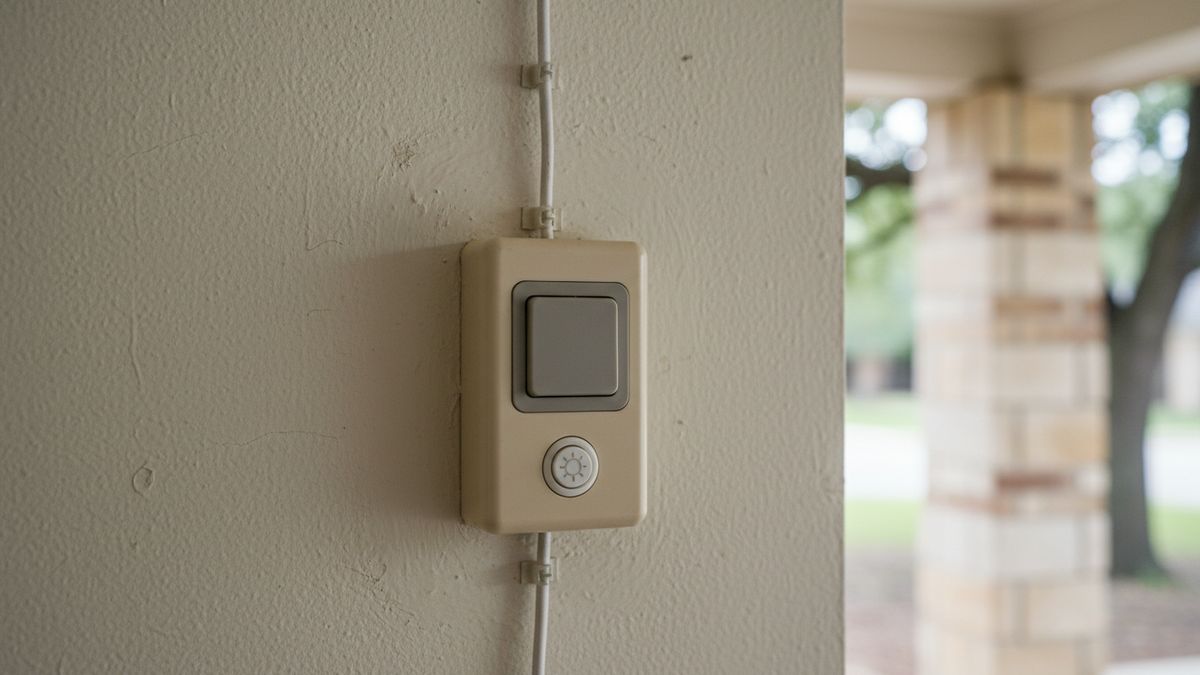
The wall button is a switch on a thin two-wire cable that runs back to the opener. Close the switch and the door moves. Anything else that connects those two wires does the same thing. A staple driven through the cable, insulation chewed by a rodent, or a nicked wire that touches a nail can short intermittently, and moisture makes it worse. That is why this version of the problem shows up after storms, and why summer thunderstorm nights here tend to produce a few of these calls.
The test is simple. Disconnect the two wall-button wires at the terminals on the back of the opener, leaving the sensor wires alone, and run the door with a remote for a few days. If the phantom opening stops, the fault is in the button or its wiring. A new wall button and a fresh run of wire is a short job.
Storms also carry surges. The National Weather Service forecast office for Williamson County issues the severe thunderstorm warnings, and unplugging the opener while one is in effect is free protection for the board.
When It Really Is the Opener
If the remotes are out, the app is clean, the wall button is disconnected, and the door still starts, stops or twitches on its own, the logic board or its receiver is failing. Heat is the usual cause here. The opener hangs from the ceiling of a garage with no air conditioning, sits well above 100 degrees for much of the summer, and its electronics age faster for it. Surges after storms and outages finish off the weak ones.
A board is a repair on a younger opener. On a unit past about fifteen years, the price of a board gets close enough to a new belt drive that replacement is usually the better money, and we will give you both numbers side by side. The details are on our garage door opener repair page, and if the door will not move at all, start with what to check when the garage door will not open.
Treat an unexplained opening as a security issue until you know otherwise. Close the door, pull the release cord and lift the manual lock bar if your door has one, or unplug the opener, until the cause is found.
More From Our Advice Pages
- Garage Door Won't Open? Eight Checks Before You CallEight checks in the order that finds the fault fastest, and the one that means stop and call.
- Battery Backup Garage Door Openers: Are They Worth It Here?What the 2023 ice storm showed, how backup batteries work, and who should pay for one.
Phantom Opening Questions
Can a neighbor's remote open my garage door?
Not with a modern rolling-code opener, unless that remote was once paired to yours. Older openers with small DIP switches used fixed codes, and two with matching switch settings could open each other. If your opener has DIP switches, it predates rolling code and is worth replacing.
Why does my garage door go back up after it closes?
Either the safety sensors saw something, or the opener met resistance near the floor and read it as an obstruction. Check that both sensor LEDs are steady, then watch the last few inches of travel for binding. Do not turn the force setting up to make it close.
Can lightning or a power surge make a garage door open by itself?
A surge can damage the logic board, and a damaged board can behave erratically, including starting on its own. Unplugging the opener during severe storms and using a surge protector at the ceiling outlet reduces the risk.
How do I erase all remotes from my garage door opener?
On most openers, press and hold the Learn button on the motor head for about six seconds, until the light next to it goes out. That clears every remote and keypad. Then pair the ones you own. Car buttons are cleared from the car's own system.
Is a door that opens by itself dangerous?
It can be, both for security and because a door that moves unexpectedly can hit a car or a person. Disable it until the cause is found by unplugging the opener or pulling the release with the door closed and using the manual lock.
Door moving on its own? We can trace it on one visit.
Open 24 hours. Wiring, remotes, boards and sensors checked before any part is swapped.