What a Hard Freeze Does to a Garage Door in Round Rock
Freezes here are rare and short, which is exactly why they catch doors out. Here is what fails, in the order it tends to fail, and what you can safely do about each.
By Garage Door Care of Round Rock · · 7 minute read
The Five Things a Freeze Breaks, Most Common First
A hard freeze in Round Rock usually causes one of five garage door problems: a bottom seal frozen to the slab, a torsion spring that snaps on the first cold cycle, an opener that stops at its force limit, stiff grease that makes the door crawl, and safety sensors fogged by condensation. The first and third are often fixable at home. A snapped spring is not, and that is our spring repair work.
What makes our freezes awkward is how seldom they happen. A garage door in a city that sees snow every year is set up for it, with cold-rated grease and an owner who knows the drill. Here, a door can go three winters without seeing 25 degrees, then sit at 10 degrees for two nights. Nothing about it was prepared, and neither was anyone in the house.
February 2021 was the extreme case. The official Central Texas record station logged lows of 8 and 7 degrees on the 15th and 16th, and NOAA's account of the Great Texas Freeze covers how long the cold held across the state. Two years later the ice came instead: Williamson County's own summary of the February 2023 storm describes up to an inch and a half of ice on roads and power lines brought down across the county. Both weeks filled our schedule with the same short list of faults.
Match the Symptom to the Cause
| What the door does | Likely cause | Safe first step |
|---|---|---|
| Opener hums, door lifts an inch, then stops | Bottom seal frozen to the concrete | Stop pressing the button. Free the seal with a plastic scraper or warm air. |
| Loud bang overnight or on the first open | Torsion spring fractured in the cold | Leave the door closed and call. Do not pull the release on a raised door. |
| Door moves slowly, then reverses halfway | Stiff grease and a force limit set in summer | Let the garage warm, try again once. Do not turn the force up. |
| Door will not close, opener light flashes | Frost or condensation on a sensor lens | Wipe both lenses dry and check the small LEDs are steady. |
| Nothing at all, no light, no hum | Power lost at the outlet or a tripped GFCI | Check the breaker and any GFCI in the garage before anything else. |
| Door opens but rattles and jerks | Rollers and hinges dry after the cold | Lubricate hinges and roller bearings once the door works normally. |
These are the patterns we see most. A door that fails in a way not on this list, or that makes a noise you have not heard before, deserves a look before it is used again.
A Frozen Bottom Seal Is the Easy One
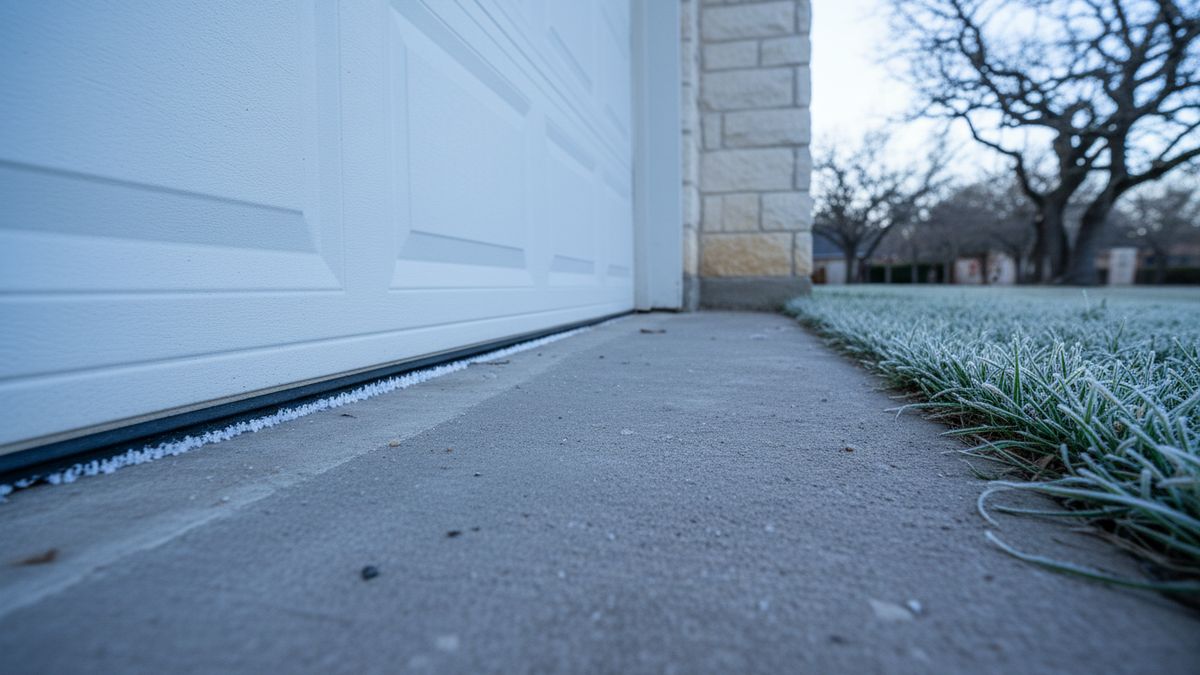
Rain or melting ice runs under the door, collects in the dip where the slab meets the seal, and freezes overnight. In the morning the opener tries to lift a door that is glued to the concrete by a strip of rubber. Most openers stop when they hit their force limit, which is the opener protecting itself rather than a fault.
Keep pressing the button and the motor wins eventually. It tears the seal out of its retainer, or it pulls the bottom section away from its brackets, or it strips the drive gear in the opener. A seal costs little. The damage from winning the argument costs more.
The fix is warmth and patience. Slide a plastic scraper along the seal line, or run a hair dryer along it from inside the garage with the door closed. Skip rock salt: it pits concrete and eats the steel of the bottom bracket over the next few years. Once the seal lets go, lift the door by hand once to confirm it is free, then let the opener take over.
If ice forms there every cold snap, the slab has a low spot at the threshold. A taller bulb seal, or a threshold strip glued to the floor, moves the water off the line where the door lands.
Why Springs Tend to Break on Cold Mornings
A torsion spring that snaps in January was usually close to done in October. Cold does not create the crack. It adds load at the moment the spring is least able to take it. Grease thickens, the door is harder to start moving, and the spring's first turn of the day carries the full weight of a stiff door. A spring near its last few hundred cycles lets go on that turn.
Door manufacturers list climate among the factors that shorten spring life: DASMA's data sheet on spring cycle life names extreme heat and cold, moisture, and missed lubrication, and recommends keeping doors closed where possible. Round Rock gives a spring all of those in one year, with a garage that bakes past 110 degrees in August and then drops below freezing for a night in January.
If you heard the bang, stop. Leave the door closed, keep your hands off the red release cord while the door is up, and do not let anyone try to lift it. A double door without its spring is 150 pounds or more of dead weight held only by the opener.
Replacing the broken spring and its twin is the usual job, since both have done the same cycles. That is covered, with prices, on our page about garage door spring repair in Round Rock.
A Ten-Minute Freeze Checklist
A hard-freeze warning from the National Weather Service forecast office for Williamson County usually gives you a day's notice, which is plenty for this:
Test the balance
3 minutesClose the door, disconnect it with the red cord, and raise it by hand to waist height. A healthy door stays put. One that drops or shoots up is a spring that will struggle in the cold.
Lubricate what moves
4 minutesHinges, roller bearings and the spring coils, with a lubricant made for garage doors. Not the tracks.
Clear the threshold
1 minuteSweep water and debris away from the seal line so nothing freezes under the door.
Know the release
2 minutesFind the red cord, and if the garage is the only way in, check whether the door has an outside key release. An outage and a freeze often arrive together.
Then keep the door closed through the cold. A door left open overnight lets the whole garage drop to outside temperature, which is harder on the spring, the opener and anything else stored there.
Why the Opener Seems Weaker in Winter
An opener is set up in whatever season it was installed. The force setting that closed a free-running door in June can be too low for the same door on a 20 degree morning, so the opener reverses halfway down, decides something is in the way, and goes back up. That is working as designed.
The wrong response is to turn the force up until the door closes. That setting stays there all year, and in May the opener will push hard enough to hurt someone before it reverses. The right one is to find out why the door got heavy: stiff grease, a tired spring, or rollers dragging in the track. Once that is fixed the summer setting works again. When the opener itself is at fault, that is opener repair rather than an adjustment.
Battery backup matters here too. Freezes and ice storms take power out, and a door that will not open is a car that cannot leave. We cover the options in our guide to battery backup garage door openers.
More From Our Advice Pages
- Battery Backup Garage Door Openers: Are They Worth It Here?What the 2023 ice storm showed, how backup batteries work, and who should pay for one.
- Garage Door Won't Open? Eight Checks Before You CallEight checks in the order that finds the fault fastest, and the one that means stop and call.
Freeze Questions We Get Every Winter
Is it safe to pour hot water on a frozen garage door seal?
It works for a minute and then makes the problem worse. The water runs under the door and refreezes as a thicker layer, and on a very cold slab it can crack the concrete surface. Warm air and a plastic scraper are slower and better.
Should I use rock salt on the driveway in front of the garage?
Keep it away from the door. Salt that reaches the seal line gets tracked into the bottom bracket and the lower section, and it speeds up rust on steel that is already the most exposed part of the door. Sand or a plain de-icing mat is kinder to the door.
Why did my garage door spring break when it was not even being used?
Springs usually break on the first cycle of a cold morning, but some go overnight with the door closed. A closed door holds the spring at full wind, and a spring with a fatigue crack can let go under that constant tension as the steel cools.
Can a hard freeze damage the opener itself?
Rarely the motor. The usual casualties are the drive gear, stripped when the opener fights a frozen door, and the logic board, when the power returns with a surge after an outage. A plug-in surge protector at the opener's outlet costs very little and protects the board.
How cold does it have to get before a garage door has problems?
Most trouble starts in the low 20s, when standing water freezes solid under the seal and grease stiffens noticeably. A single night just below freezing rarely does anything. A multi-day hard freeze is when the calls start.
Door stuck on a freezing morning? Call before you force it.
Open 24 hours. We will tell you what is safe to try while the van is on its way.