How to Measure a Garage Door Opening Before You Buy
Five measurements decide which door will fit, which track it needs and whether the opener can stay. Take them once, carefully, and the quote you get is the price you pay.
By Garage Door Care of Round Rock · · 7 minute read
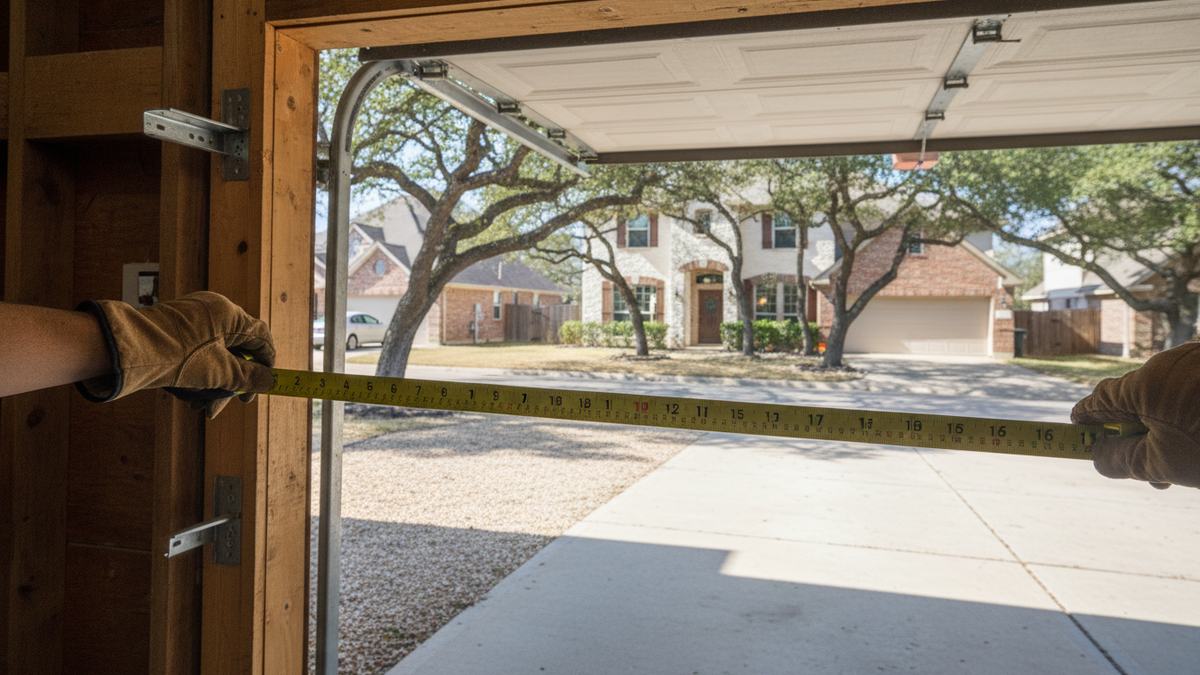
The Five Numbers That Matter
To measure for a new garage door, take five numbers: the opening width, the opening height, the headroom above the opening, the backroom from the opening to the back wall, and the side room on each side. Width and height choose the door. Headroom, backroom and side room choose the track and spring system, and they are the numbers people skip. All five together are what a proper garage door installation quote is built on.
Measure the opening, not the old door. The door overlaps the opening by an inch or so on each side and at the top, so a door measured at 16 feet 2 inches still goes in a 16 foot opening. Round Rock builder homes mostly have 16 by 7 foot doubles and 8 or 9 by 7 foot singles, with 8 foot tall doors increasingly common in homes built since about 2010.
Each Measurement, Where to Take It and What It Decides
| Measurement | Where to measure | What it decides |
|---|---|---|
| Opening width | Finished opening, jamb to jamb, at the widest point | Door width |
| Opening height | Floor to the underside of the header, at the highest point | Door height |
| Headroom | Top of the opening up to the ceiling or the lowest obstruction | Standard or low-headroom track, and where the spring sits |
| Backroom | From the opening back into the garage, clear of obstructions | Whether the track and the opener rail fit |
| Side room | From the edge of the opening to the side wall, each side | Space for track brackets and spring hardware |
Measure Twice, in Three Places
Openings are rarely perfect rectangles, especially on the east side of the city where the slab moves with the clay. Measure the width at the top, the middle and near the floor, and the height at both sides and the middle. Write down the largest of each. If the numbers differ by more than about half an inch, note that too, because it means the opening has moved and the jambs may need attention before a new door will seal.
Look at the wood jambs and header while you are there. Soft wood at the bottom of a jamb, where water sits after storms, is common here. New track screws into those jambs, and they need sound wood to hold. Rot is cheaper to replace before the new door goes up than after.
The Measurement That Decides the Track
Headroom is the space between the top of the opening and the ceiling, or the lowest thing hanging from it, whether that is a duct, a beam, a light or a garage storage rack. It decides whether the door can use a standard track with the torsion spring above the opening, or needs a low-headroom kit.
A standard torsion setup typically wants around a foot of headroom. Clopay's guide to garage door track options sets out what the alternatives need: a front-mount low-headroom track typically needs about 9 inches, and a rear-mount one can work with as little as 4.5 inches. Low-headroom hardware costs more and moves the spring toward the back of the track, so it is worth knowing your number before you fall in love with a door.
Measure headroom at the middle of the opening and at both sides. A beam that crosses near one side is easy to miss and will stop a track dead.
The Room Behind and Beside the Door
Backroom is the depth the door needs when it is fully open, lying flat under the ceiling on its horizontal tracks. Clopay's guide puts standard-track backroom at door height plus 16 inches, and more for low-headroom track. An opener rail needs a little more again. Freezers, shelving and storage racks near the ceiling are the usual obstacles.
Side room is the space from each edge of the opening to the side wall. The same Clopay guide calls for at least 4.5 inches for standard track, and more for some low-headroom layouts. Three-car garages in Round Rock often have a narrow pier between two doors, so measure both sides of that pier.
A heavier door needs different springs. Insulated doors are heavier than the thin builder doors they usually replace. The springs have to be sized to the new door, never carried over, and DASMA's spring life data sheet warns that a spring lifting more than it was sized for wears out early.
Three Checks People Miss
- The opener. An opener past about twelve years is worth deciding on at the same time, since the installer is already there and the new door will be heavier. Our guide to battery backup openers covers one option worth adding.
- The HOA. Many Round Rock subdivisions have deed restrictions that cover door style and color. Get the approval in writing before ordering a door that is built to order and cannot be returned.
- The city. Check the City of Round Rock building inspection page for its current permit rules before the fit date.
Or skip the tape measure entirely. Every installation quote we give starts with us measuring the opening, headroom, backroom and side room, checking the jambs and looking at the opener, so the price you hear is for a door that fits. That is also why we can tell you honestly when a repair is the better buy than a new door.
Styles That Suit Round Rock Houses
Once the numbers are settled, the choice is mostly about the house. A few patterns work well on the limestone and brick fronts that dominate the city.
- Short or long raised panels in a neutral color are the safe choice on builder homes from the 1990s and 2000s, and they suit most HOA guidelines
- Carriage-house styling, with faux hinges and handles, pairs well with the rough-cut limestone on many newer elevations
- Windows in the top section brighten a garage used as a workshop, and frosted glass keeps the contents private
- An insulated door is worth it if there is a room above the garage or the door faces west, since an uninsulated steel door radiates summer heat straight into the garage
Color matters more than people expect on a stone house. A door matched to the trim or the window frames usually looks better than one matched to the stone itself, which varies from block to block. Bring a sample to the driveway and look at it at different times of day before you order.
Four Measuring Mistakes That Cost Weeks
Measuring the door, not the opening
Most commonThe old door overlaps the jambs, so its size overstates the opening. Order from that figure and the new door will not sit in the stops properly.
Taking one height reading
East side especiallyA slab that has settled at one corner makes the opening taller on one side. Measure both sides and the middle, and order for the tallest.
Forgetting the opener rail
Low garagesThe opener needs a little clearance above the door's highest point of travel. A storage rack or duct that clears the door can still block the rail.
Ignoring the pier between doors
Three-car garagesTwo doors share one narrow pier. Both need their side room from it, and a pier that is a few inches short changes the hardware for both doors.
None of these is hard to get right. They are simply easy to skip when the tape measure is out for the first time.
More From Our Advice Pages
- Hiring a Garage Door Company: Red Flags and Fair QuestionsThe pricing tricks and upsells to watch for, and seven questions for the first phone call.
- Sealing the Gaps Around a Garage Door: Scorpions, Dust and Cedar PollenThe daylight test, the five places a door leaks, and the seal that fixes each one.
Measuring Questions
Do I measure the old garage door or the opening?
The opening. The door overlaps the opening by about an inch on each side and at the top. Measure the finished opening between the jambs and from the floor to the header, at several points, and use the largest figures.
What if I do not have enough headroom for a standard garage door?
A low-headroom track kit moves the spring hardware and changes the track path so the door can open in less space. Clopay's track guide lists front-mount low-headroom track at about 9 inches and rear-mount at about 4.5 inches. It costs more and must be ordered with the door.
What are the most common garage door sizes in Round Rock?
Double doors are mostly 16 feet wide by 7 feet tall, and singles are 8 or 9 feet by 7 feet. Homes built in the last decade or so increasingly have 8 foot tall doors.
Can I reuse my old springs with a new garage door?
No. Springs are sized to the weight of the door. A new door, especially an insulated one, almost always weighs more than the builder door it replaces, and reused springs will leave it out of balance and wear out quickly.
How long does it take to get a new garage door after measuring?
Stock sizes and colors usually arrive within a few days to a couple of weeks. Custom colors, windows and special sizes take longer. We book the installation once the door is here.
Rather we measured it? That is the first step of every quote.
Open 24 hours. Measured, priced and ordered with the right track the first time.